The Starbucks Korea Tank Day controversy has shaken one of South Korea’s most ubiquitous coffee chains to its core — ending in a CEO firing, a national boycott, and an apology from Starbucks’ U.S. headquarters. What started as a tumbler promotion became a crisis that exposed deep wounds in Korean historical memory.
What Happened
On May 18, 2026 — the 46th anniversary of South Korea’s Gwangju Uprising — Starbucks Korea ran a promotional campaign for a new tumbler called the “Tank.” The marketing materials labeled the day “Tank Day” and included the Korean phrase “책상에 탁!” — roughly translating to “a bang on the desk.”
To most outside Korea, this might read as harmless promotional copy. To Koreans, both phrases hit like open wounds.

Why the Starbucks Korea Tank Day Controversy Cut So Deep
To understand the outrage, you need to know what May 18th means in Korea.
In 1980, citizens in the city of Gwangju rose up against the military dictatorship of General Chun Doo-hwan. The government’s response was brutal: paratroopers and armored military vehicles — including tanks — were deployed against unarmed civilians. Hundreds were killed. The Gwangju Uprising became a defining moment in South Korea’s long and painful road to democracy, and May 18th is now a national day of mourning and remembrance.
The phrase “a bang on the desk” carries its own dark history. In 1987, a university student named Park Jong-chul was tortured to death by police during an interrogation. When the death was made public, the government’s spokesperson infamously tried to downplay it by claiming the student had simply died from shock when an interrogator “banged on the desk.” The cover-up became a symbol of the regime’s brutality and sparked the nationwide pro-democracy protests that ultimately ended military rule.
Starbucks Korea used both references — whether intentionally or not — in a single promotional image, on the exact anniversary of the Gwangju massacre.
The Fallout
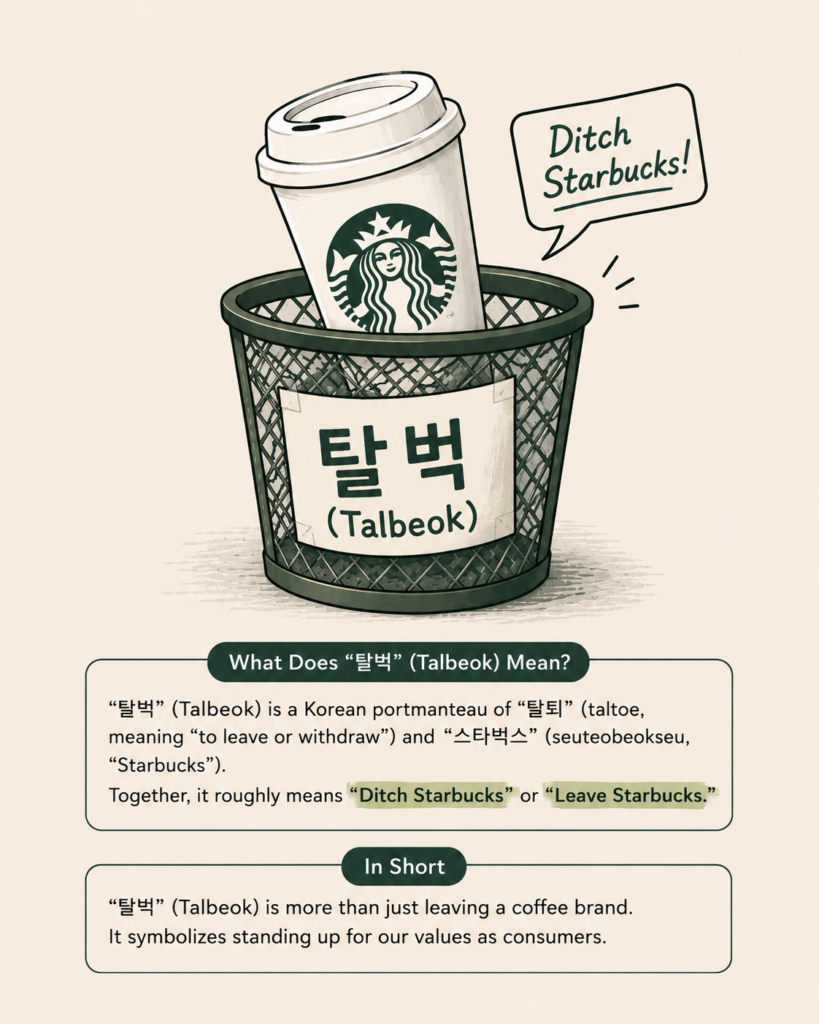
Public anger was immediate and intense. Social media erupted with calls for a boycott, with the hashtag movement “탈벅” (roughly, “Ditch Starbucks”) spreading rapidly online. One Gwangju resident said the campaign was “beyond incomprehensible.”
South Korean President Lee Jae-myung weighed in directly, posting on social media that he was “furious at the inhumane behavior of these low-grade merchants who deny the values of the Korean community, basic human rights, and democracy.”
Shinsegae Group — the Korean conglomerate that owns and operates Starbucks Korea — moved swiftly to contain the crisis. CEO Son Jeong-hyun was fired, the marketing executives responsible were dismissed, and Group Chairman Jeong Yong-jin issued a public apology, stating: “This was inappropriate marketing that should never have happened and cannot be tolerated.”
Starbucks’ U.S. headquarters also issued a formal apology, calling the campaign something that “should never have occurred, regardless of intent,” and pledging to strengthen internal oversight and company-wide education.
The Bigger Picture
It is worth noting that Starbucks Korea is no longer affiliated with the American Starbucks corporation in the traditional sense. The U.S. parent company sold its full stake in the Korean operation, which is now entirely owned by Shinsegae Group — one of South Korea’s largest retail conglomerates. The brand name is licensed, but the business decisions are entirely Korean.
That context matters. This was not a foreign company stumbling into unfamiliar cultural territory. This was a Korean company, operating in Korea, that either failed to notice — or chose to ignore — what May 18th means to the country it operates in.
Whether this was negligence or something worse, the damage is done. And in a country where historical memory runs deep, the road back to public trust will be long.